
Send Us A Message
Hot Dip Galvanizing Manufacturing Process
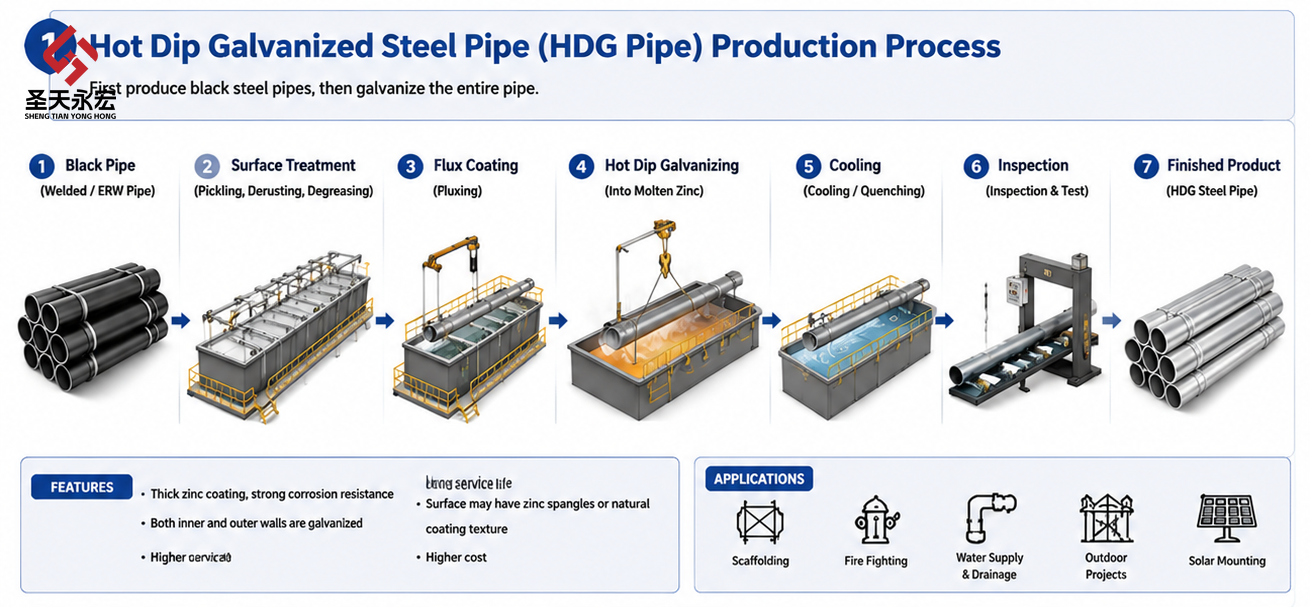
Hot Dip Galvanized Steel Pipe Manufacturing Process
Content Details
What is Hot Dip Galvanized Steel Pipe?
Hot Dip Galvanized Steel Pipe is manufactured by coating carbon steel pipes with a protective zinc layer through a hot dip galvanizing process. The process involves cleaning the surface of black steel pipes and immersing them into molten zinc to form a strong metallurgical bond between steel and zinc coating.
Compared with ordinary black steel pipes, hot dip galvanized steel pipes provide excellent corrosion resistance, longer service life, and better protection in outdoor and harsh environments.
During production, steel pipes are processed through surface treatment, flux coating, hot dip galvanizing, cooling, inspection, and finishing procedures to produce high-quality galvanized steel pipes with uniform zinc coating and reliable performance.
Hot dip galvanized steel pipes are widely used in construction, scaffolding, fire protection systems, water supply, greenhouse structures, fencing, and industrial applications.
Manufacturing Process of Hot Dip Galvanized Steel Pipe
1. Black Steel Pipe Preparation
The production process starts with high-quality black steel pipes, usually manufactured through ERW (Electric Resistance Welding) technology.
Before galvanizing, steel pipes are inspected to ensure they meet international standards and customer requirements.
The inspection includes:
- Chemical composition
- Steel grade
- Pipe dimensions
- Surface condition
- Mechanical properties
Common steel grades include:
- Q235
- Q355
- S235JR
- S355JR
- ASTM A53
- ASTM A500
2. Surface Treatment Process
Before hot dip galvanizing, black steel pipes undergo surface preparation to remove impurities and ensure strong zinc adhesion.
The surface treatment process includes:
- Degreasing
- Pickling
- Rust removal
- Water rinsing
This process helps:
- Remove oil, rust, and oxide layers
- Improve zinc coating adhesion
- Ensure uniform galvanizing quality
Proper surface treatment is essential for producing durable galvanized steel pipes.
3. Flux Coating Process
After surface cleaning, steel pipes are immersed in a flux solution.
The flux coating process helps:
- Prevent oxidation before galvanizing
- Improve the bonding between steel and molten zinc
- Ensure complete zinc coverage
A proper flux treatment ensures smooth and consistent zinc coating during the galvanizing process.
4. Hot Dip Galvanizing Process
After flux coating, steel pipes are immersed into a molten zinc bath at approximately 450°C.
During this process:
- Zinc reacts with the steel surface
- A strong zinc-iron alloy layer is formed
- The pipe surface is covered with a protective zinc coating
The hot dip galvanizing process provides:
- Excellent corrosion resistance
- Long service life
- Strong surface protection
- Uniform coating thickness
5. Cooling and Finishing Process
After leaving the zinc bath, galvanized steel pipes are cooled and stabilized.
The cooling process helps:
- Solidify the zinc coating
- Improve coating durability
- Maintain surface appearance
Additional finishing operations may include:
- Zinc spangle control
- Surface cleaning
- Threading
- Marking
6. Cutting and Processing
After cooling, galvanized steel pipes are processed according to customer requirements.
The process includes:
- Cutting into standard lengths
- End finishing
- Pipe threading
- Surface checking
Common lengths include:
- 6 meters
- 12 meters
- Customized lengths
7. Quality Inspection
Finished hot dip galvanized steel pipes undergo strict quality inspection before shipment.
Each product is inspected for:
Chemical Composition
Checking carbon content and alloy elements to ensure compliance with material standards.
Mechanical Properties
Testing:
- Yield strength
- Tensile strength
- Elongation
Dimensional Accuracy
Checking:
- Outer diameter
- Wall thickness
- Length
- Straightness
Zinc Coating Quality
Inspecting:
- Zinc coating thickness
- Coating uniformity
- Surface appearance
Quality inspection ensures galvanized pipes meet international standards and customer requirements.
8. Packaging and Delivery
Qualified hot dip galvanized steel pipes are bundled and prepared for international transportation.
Common packaging methods include:
- Steel strip bundling
- Waterproof wrapping
- Plastic caps protection
- Customized marking
- Container loading
Proper packaging helps prevent damage during storage and overseas transportation.
Difference Between Hot Dip Galvanized Steel Pipe and Black Steel Pipe
Advantages of Hot Dip Galvanized Steel Pipe
1. Excellent Corrosion Resistance
The zinc coating provides strong protection against rust and corrosion, extending the service life of steel pipes in outdoor environments.
2. Long Service Life
Hot dip galvanized steel pipes can maintain stable performance for many years with minimal maintenance.
3. Complete Surface Protection
The galvanizing process covers both external surfaces and provides reliable protection for the entire pipe.
4. Cost Effective Solution
Although the initial cost is higher than black steel pipes, galvanized pipes reduce maintenance costs over the long term.
5. Wide Range of Applications
Different sizes, wall thicknesses, and steel grades are available to meet various project requirements.
Applications of Hot Dip Galvanized Steel Pipe
Hot dip galvanized steel pipes are widely used in:
Construction Industry
Used for:
- Scaffolding systems
- Steel structures
- Building frameworks
- Fencing projects
Fire Protection Systems
Used for:
- Fire sprinkler pipelines
- Fire water transportation systems
Water Supply Projects
Used for:
- Water pipelines
- Drainage systems
- Outdoor facilities
Industrial Applications
Used for:
- Factory structures
- Machinery supports
- Greenhouse frames
Energy Projects
Used for:
- Solar mounting structures
- Outdoor support systems
Why Choose Our Hot Dip Galvanized Steel Pipe Products?
We supply high-quality hot dip galvanized steel pipes with advanced galvanizing technology and strict quality control systems.
Our advantages include:
- High-quality carbon steel materials
- Uniform zinc coating
- Various sizes and specifications available
- Customized production solutions
- Professional export packaging
- Compliance with international standards
Our hot dip galvanized steel pipes are suitable for construction, infrastructure, industrial, and engineering projects worldwide.